Let us deal with the thing everybody asks first, because it stops people calling for weeks and those weeks matter.
The reason early detection matters so much is that the difficulty of treatment scales with how far the population has spread. Caught in one bed frame, it is a contained job. Caught six months later, it is in the sofa, the adjoining bedroom, and possibly the unit next door.
The five signs, in the order you will notice them
- 01
Bites in lines or clusters
Usually on skin exposed while sleeping — arms, shoulders, neck, ankles. The line pattern is characteristic. Worth knowing: reactions vary enormously, and some people show nothing at all while sharing the same bed as someone covered in bites. Bites alone are a prompt to inspect, not a diagnosis.
- 02
Rust or blood spotting on bedding
Small reddish-brown marks on sheets, particularly near the edges of the mattress. This is often the first physical evidence people find.
- 03
Dark specks in the seams
Digested blood, appearing as small dark dots concentrated along mattress piping, the joints of the bed frame, and the underside of the headboard. Clusters rather than scattered marks.
- 04
Shed skins and eggs
Pale, translucent casings along the same seams and joints. Bed bugs moult as they grow, so shed skins indicate an established population rather than a single hitchhiker.
- 05
The smell
A sweet, musty odour in a heavily affected room. If you can smell it, the population is well established and you should not wait.
Where to actually look
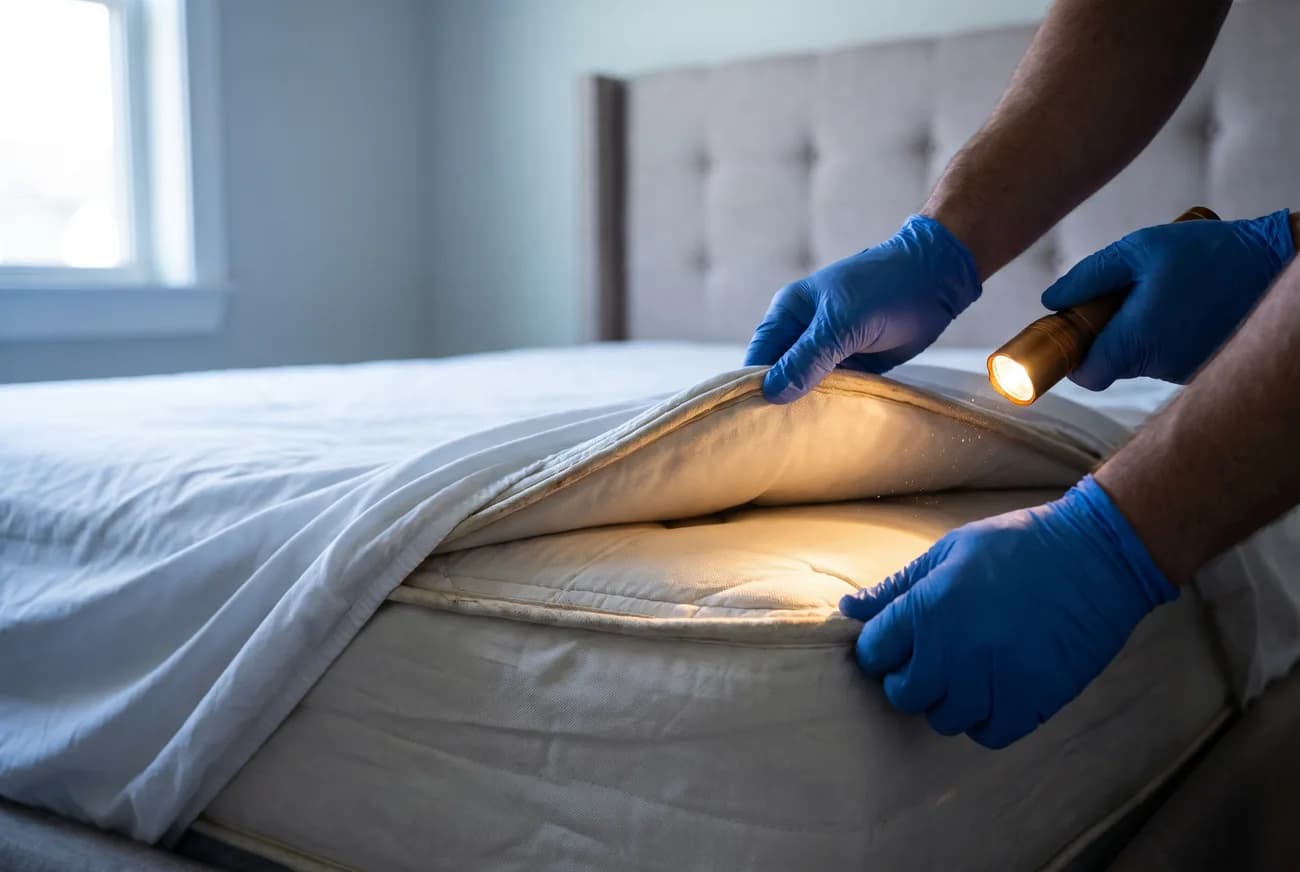
Bed bugs shelter within a few feet of where people sleep, in tight seams and joints. Take the bedding off, use a bright torch, and work through this order:
- Mattress piping and seams, all the way round, including the underside
- The box spring — especially the stapled fabric underneath, which is a favourite
- Every joint and screw hole in the bed frame and headboard
- The headboard where it meets the wall, and behind it
- Nightstand drawers, joints and runners
- Baseboards and outlet covers on the wall behind the bed
- Upholstered chairs and sofas where someone regularly falls asleep
What not to do first
Two instincts make things worse, and both are extremely common.
Do not start sleeping in another room
It is the most natural reaction and it spreads the infestation. Bed bugs follow their host — move to the sofa, and within a couple of weeks the sofa is infested too. You have then turned one room into two. Stay where you are until treatment is planned.
Do not throw the mattress out yet
Most mattresses can be treated and kept, sometimes with an encasement afterwards. Dragging an infested mattress through a hallway or a lift sheds bugs and eggs along the entire route, which in an apartment building is how a single-unit problem becomes a building problem. If a mattress genuinely has to go, it should be wrapped and sealed before it moves.
What proper treatment involves
- 01
Inspection and mapping
Confirming the species and establishing how far it has travelled — including adjoining rooms and, in multi-unit buildings, the neighbouring units. Getting the extent right here is what prevents a second round.
- 02
Preparation you are told about in advance
Laundering, bagging, decluttering, and clearing access to the bed frame and baseboards. Preparation genuinely affects whether treatment holds, so we give a specific list rather than vague advice.
- 03
Licensed treatment
Applied across the harbourage areas and chosen for the property and the level of infestation, by an Alberta-licensed technician.
- 04
Follow-up verification
Expect a return visit rather than a single appointment. The first treatment handles the active population; the follow-up confirms that eggs hatching afterwards have been dealt with. And our results are guaranteed.
If you rent
Responsibility for treatment depends on your lease and your building, and it is not something to guess at. What is always useful is a professional inspection that confirms what you are dealing with in writing — that gives you something concrete to take to your landlord or property manager. We work with Calgary property managers on multi-unit buildings regularly, and a documented inspection tends to move things along considerably faster than a phone call describing bites.