Bird work is the part of pest control that behaves least like pest control. There is nothing to spray and nothing to bait. It is a building problem, solved with physical exclusion, and it succeeds or fails almost entirely on the specification.
If you manage a commercial or multi-unit property in Calgary, this is the practical version of what you need to know before approving a quote.
Why it stops being cosmetic
- Droppings are acidic and degrade cladding, stonework, paint and vehicle finishes over time
- Nesting material blocks gutters, scuppers and roof drains, which turns a bird problem into a water-ingress problem
- Accumulated droppings in occupied areas are a health matter and a complaint generator
- For food premises and public-facing buildings, visible roosting is an inspection and reputation risk
- Nests in HVAC housings and roof plant restrict airflow and create service access problems
The four systems, and where each one belongs
Spikes
Correct for narrow ledges with light landing pressure. They prevent a bird settling on a surface a few inches wide. Where they get misused is on wide ledges and recessed areas — birds simply nest behind or between them, and within a season you have spikes with a nest built around them. Spikes deter landing; they do not close a space.
Post-and-wire
Tensioned wire on posts, creating an unstable landing edge. Visually discreet, which makes it the usual answer on heritage frontages and architectural stonework where appearance is a constraint. Effective for light-to-moderate pressure on narrow runs.
Netting
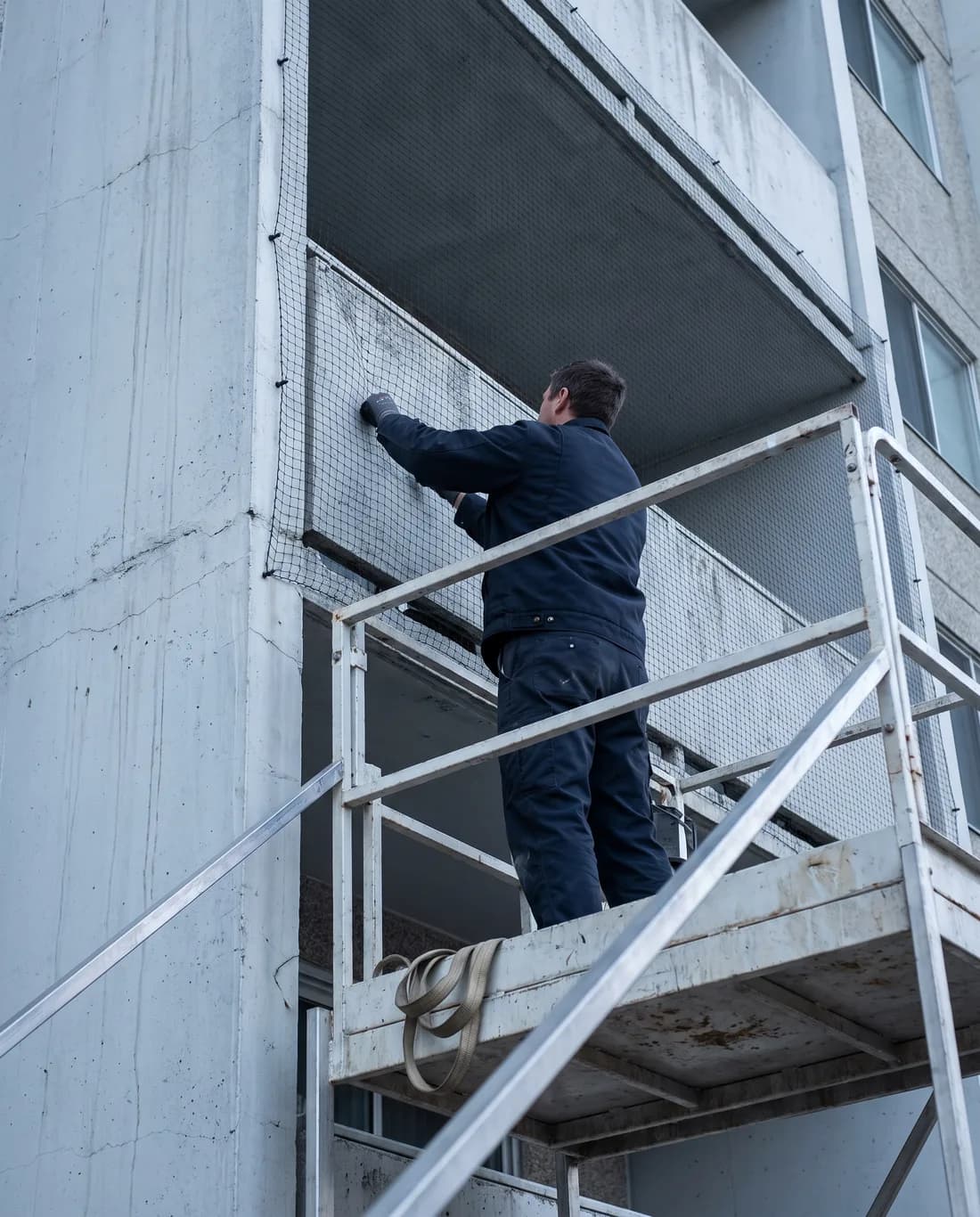
The answer for volume rather than edge. Balconies, recessed courtyards, parapets, roof plant areas, canopies, loading bays — anywhere birds have room to get in behind a deterrent. Netting closes the whole volume, which is why it is the standard specification for balconies and open parapets. Correctly tensioned and anchored, it is a multi-year fix.
Optical and gel deterrents
Useful as a supplement in specific situations. Treat them as a supporting measure rather than a primary system on a property with established roosting — birds habituate to anything that does not physically prevent access.
The right sequence
- 01
Survey the whole building
Roosting points, nesting points, species, pressure level, and the conditions making the building attractive. For commercial work this should come with documentation you can put in front of an owner or a board.
- 02
Clear before you close
Accumulated droppings and nesting material are cleared and the area cleaned down first. Installing exclusion over existing mess seals the health issue in and guarantees a callback.
- 03
Install the right system for each surface
Most buildings need more than one. A parapet, a balcony and a signage recess are three different specifications on the same elevation.
- 04
Proof the cavities
Voids, openings and nesting cavities are closed so the population does not relocate along the same structure.
- 05
Schedule monitoring
Calgary winters and the spring nesting season both put load on an installed system. Scheduled checks catch a failed anchor before it becomes an open route back in.
Timing the work
Exclusion is best installed outside active nesting. Once nesting is underway the job becomes more complicated and more constrained, so a property with a known recurring problem is far better dealt with ahead of the season than during it. If you already know which elevation will generate complaints in spring, that is the one to survey in late winter.
Working on an occupied building
Most installs are carried out from a lift or from the roof, and the disruption is usually less than people expect. On occupied multi-unit properties the work can be staged floor by floor so no resident loses balcony access for any length of time. Getting the staging plan agreed before work starts is what keeps the tenant complaints down while you are fixing the tenant complaints.